

Thinking about hitting the road on an e-bike in Ontario? The good news is, it's wonderfully simple. If you’re a new rider looking for a comfortable and easy way to get around, you've come to the right place.
If you’re at least 16 years old, wear an approved helmet, and your e-bike’s motor is 500 watts or less with a top speed of 32 km/h, you're pretty much set. Best of all, you won't need a licence, registration, or insurance to get out there and ride. It's the perfect way to explore your neighbourhood in Toronto or enjoy the beautiful trails in Saskatoon.
For new riders who want a bike that’s incredibly easy to hop on and off, we highly recommend the Biktrix Stunner Step-Thru. It’s fully compliant, comfortable, and perfect for your first e-bike adventure.
Explore the Biktrix Stunner Step-Thru Today
Your Simple Guide to Ontario E-Bike Rules
So, you're looking at an electric bike and wondering about the rules here in Ontario. You've come to the right place. We're going to break down everything you need to know to ride legally and safely, without any of the confusing legal-speak.
Think of an e-bike's motor as a 'helpful push' rather than a full-blown engine—it’s there to assist your pedalling, not to turn your bicycle into a motorcycle. If you want to dive deeper into the mechanics, you can learn more about how an electric bike works in our detailed guide.
But first, let's get you up to speed on the essentials.
How Did We Get Here? A Brief History of Ontario's E-Bike Laws
Ontario was actually one of the last provinces to officially set the rules for what they call power-assisted bicycles (or PABs). Back in 2009, the government laid down the law to make sure e-bikes could safely share the road with regular bikes and cars.
These new regulations established the technical specs for any e-bike sold and used in the province: a top assisted speed of 32 km/h, a maximum weight of 120 kilograms, and a required braking distance of no more than nine metres. It was all about creating a clear standard for this new way of getting around.
This guide is your cheat sheet for worry-free riding, whether you're cruising Vancouver's Stanley Park seawall or exploring the beautiful bike paths in Ottawa. Our goal is to get you feeling confident and informed so your e-bike journey is safe, legal, and a ton of fun from day one.
To make things even easier, here's a quick summary of the key provincial rules in a handy table.
Ontario E-Bike Laws at a Glance
This table breaks down the most important rules you need to know before you start riding. Think of it as your quick reference guide.
| Requirement | What You Need to Know |
|---|---|
| Minimum Age | You must be 16 years or older to operate an e-bike. |
| Helmet | An approved bicycle or motorcycle helmet is mandatory for all riders. |
| Motor & Speed | The motor cannot exceed 500 watts, and speed assistance must cut off at 32 km/h. |
| Pedals | Your e-bike must have working pedals at all times. No pedals, no go! |
| Licence/Insurance | No driver's licence, vehicle registration, or insurance is required for a compliant e-bike. |
| Compliance Label | The e-bike must have a permanent label from the manufacturer stating it meets all necessary federal and provincial standards. |
Stick to these guidelines, and you’ll be all set to enjoy the freedom of riding an e-bike across Ontario.
What Defines a Legal E-Bike in Ontario
So, what exactly makes an e-bike, an e-bike in the eyes of Ontario law? It’s simpler than it sounds, and getting a handle on the official definition is your best tool when you’re shopping for your first ride. Knowing the rules helps you pick a model that's good to go, right out of our showrooms in Vancouver or Saskatoon.
In Ontario, a compliant e-bike isn't considered a motorcycle or a moped. It has its own special classification: a "power-assisted bicycle" (or PAB). This is the key that unlocks the freedom from needing a licence, registration, or plates. But to earn that PAB title, an e-bike has to tick three specific boxes.
The Three Pillars of a Legal Ontario E-Bike
Think of these three rules as the DNA of a legal e-bike. If a bike you’re looking at doesn't meet all three, the province won't see it as a power-assisted bicycle—it'll likely be classified as an unlicensed motor vehicle, and that’s a whole different ball game.
- It Must Have Working Pedals: This is non-negotiable. An e-bike has to have pedals that can actually move the bike forward. You can't just take them off; the bike needs to be able to function like a regular bicycle at all times.
- The Motor Cannot Exceed 500 Watts: That little boost you get from the motor has a legal limit. In Ontario, the motor’s continuous power output can’t be more than 500 watts. Anything stronger pushes it into motorcycle territory.
- Power Assistance Must Stop at 32 km/h: The motor is there to help you out, not to turn your bike into a rocket. As soon as you hit 32 km/h, the motor has to cut out completely. You can definitely go faster by pedalling hard or coasting down a hill, but the motor won’t give you any more juice beyond that speed.
These rules are also super important if you're thinking about a DIY build. Our guide on electric bike conversion kits in Canada can walk you through how to make sure your project is fully compliant.
To keep it simple, here’s a quick visual that breaks down the basics for a legal ride in Ontario.
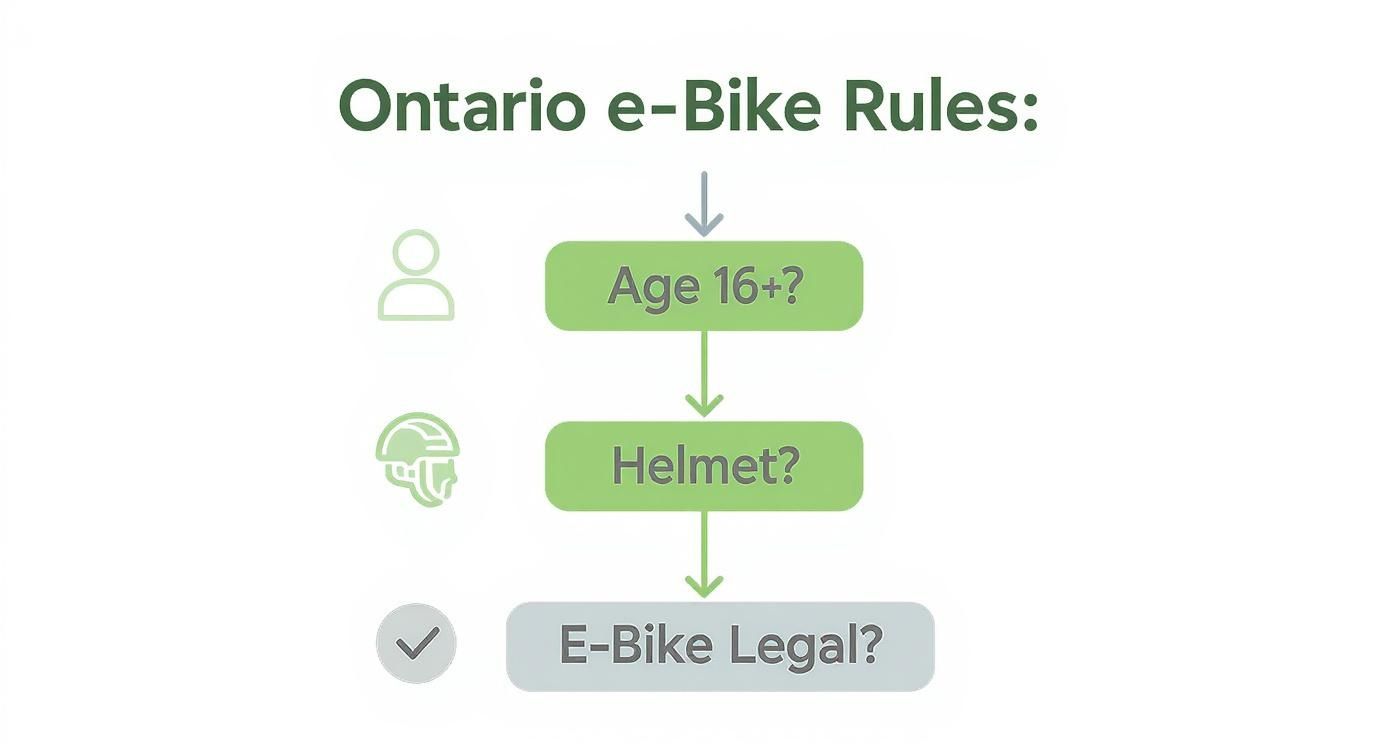
As you can see, it boils down to being at least 16, wearing a helmet, and riding a bike that meets the legal definition. That's your recipe for a safe and legal trip.
Look for the Label of Compliance
How can you be sure a bike you're looking at meets these standards without busting out a multimeter? Thankfully, reputable manufacturers have made it easy for you.
Every new e-bike sold in Canada is required to have a permanent label from the manufacturer right on the frame. This sticker is your proof that the vehicle is a certified power-assisted bicycle and meets all the necessary federal and provincial rules.
When you're shopping, always look for this compliance sticker. It’s the manufacturer's official seal of approval, telling you the bike is 100% legal for Ontario's roads and paths. It takes all the guesswork out of the process.
This little label confirms everything you need to know: the motor's power, its maximum assisted speed, and its official PAB classification. It’s a simple check that gives you total peace of mind.
Understanding this legal distinction also clarifies what doesn't apply to e-bike riders. For instance, you don't have to worry about the province's complex no-fault insurance system because your e-bike isn't legally a motor vehicle. By sticking with a compliant PAB, you get to keep your ride simple, fun, and hassle-free—just like a regular bike.
Essential Rules of the Road for Riders
Alright, you’ve got a perfectly legal e-bike, and you're ready to roll. Let the fun begin! But just like driving a car, there are a few simple rules of the road to keep in mind. Think of this as your quick-start guide to riding with confidence anywhere in Ontario.
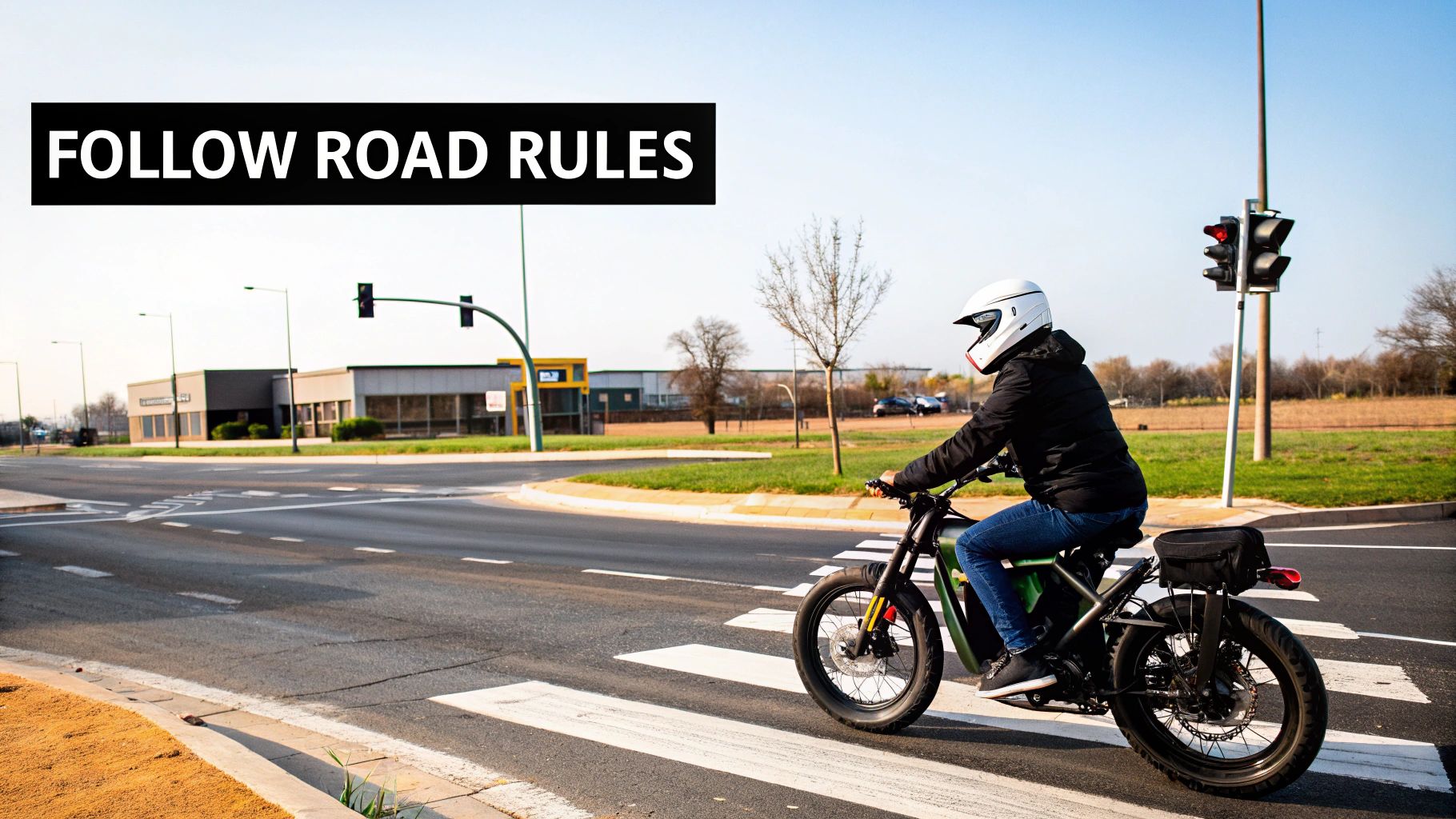
The good news? It's all refreshingly straightforward. Ontario's goal was to make e-biking easy and accessible, which means you don’t need to memorize a massive rulebook. A few key points are all it takes to share the road like a pro.
Age and Helmet Requirements
First things first, let’s cover the two absolute musts for every single rider. These are the big ones for safety.
- You must be at least 16 years old to legally ride an e-bike on public roads in Ontario. This ensures riders have the maturity and road-sense needed for the extra speed and weight of an e-bike.
- You must wear an approved helmet every time you ride. No exceptions here—this applies to everyone, regardless of age. It can be a bicycle or motorcycle helmet, as long as it’s in good shape and strapped on securely.
These core safety rules have been around since the beginning. The original regulations from October 2009 set the minimum age and also established the maximum e-bike weight at 120 kilograms and a required braking distance of 9 metres. You can dig deeper into the research behind these rules in this transportation research paper.
The Best News: No Licence or Insurance Needed
This is where riding an e-bike gets wonderfully simple. Because your compliant bike is legally a "power-assisted bicycle" and not a motor vehicle, you get to sidestep a whole lot of red tape.
It’s one of the biggest perks of choosing a legal e-bike. You do not need a driver's licence, vehicle permit, licence plate, or automobile insurance to ride in Ontario. Think of the savings in time, money, and paperwork!
This freedom is exactly what makes e-bikes such a fantastic and approachable choice for so many people. It means you can just hop on and go, whether you're off to the grocery store in Calgary or exploring scenic trails around Victoria.
Sharing the Road Safely
While you don't need a driver's licence, you are still expected to follow the same traffic laws as any other cyclist. The Ontario Highway Traffic Act applies to e-bike riders just as it does to everyone else. It’s all about being predictable and safe, which keeps you and the people around you protected. For more advice geared toward mature riders, check out our guide on electric bike riding tips for seniors.
The easiest way to think about it is this: if you'd do it in a car, do it on your e-bike.
Here are the key things to always keep in mind:
- Obey all traffic signals and signs: That means stopping at red lights and stop signs, and yielding when you're supposed to.
- Use your hand signals: Let drivers and other cyclists know what you're planning to do. Signal your turns and stops clearly.
- Ride on the right side of the road: Always travel in the same direction as traffic, staying as far to the right as is safe and practical.
- Be seen at night: If you’re riding between dusk and dawn, your e-bike must have a white front light and a red rear light or reflector.
Following these simple rules means you can share the road with confidence and courtesy, whether you're navigating downtown Hamilton or cruising down a quiet country road.
Where You Can (and Cannot) Ride Your E-Bike
Figuring out exactly where your new e-bike is welcome can feel a bit murky at first. But the good news is that the main provincial rule is beautifully simple: if a regular bicycle can go there, your e-bike is generally welcome, too.
This simple principle opens up a huge network of Ontario’s roads, streets, and dedicated bike lanes. It means you can confidently pedal-assist your way through your daily commute or enjoy a leisurely ride along a waterfront path in Kelowna.
The real trick, though, is understanding that local towns and cities get the final say on their own turf—especially when it comes to parks and trails. This is where things can get a little different from one municipality to the next.
Navigating the Maze of Local Bylaws
That freedom for municipalities to set their own rules is the single most important thing to keep in mind. A trail that embraces e-bikes in one town might have a completely different policy just one jurisdiction over.
Major hubs like Toronto, Ottawa, and London all have specific bylaws governing e-bike access, particularly for multi-use trails, conservation areas, and parklands. For example, some sensitive natural areas, like Gatineau Park near Ottawa, prohibit all power-assisted vehicles to protect the local ecosystem and keep the trails safe for pedestrians.
Getting into the habit of doing a quick check before heading to a new spot is a game-changer. A quick search for "[City Name] e-bike bylaws" or "trail rules" on the local municipality's website can save you a ton of hassle and a potential fine. And of course, always keep an eye out for signs at trailheads—they’re your most immediate and reliable guide.
The golden rule is this: when in doubt, check it out. A few minutes of research before you ride ensures your adventure is all fun and no fuss, letting you just relax and enjoy the scenery.
Knowing about these local quirks helps you plan your trips with confidence, so you can focus on the ride itself without any second-guessing.
Where Can You Ride Your E-Bike in Ontario?
To give you a clearer picture, here's a quick cheat sheet on where e-bikes are usually permitted. Just remember, this is a general guide—local bylaws can always create exceptions.
| Location Type | Generally Permitted? | Important Note |
|---|---|---|
| Roads & Highways | Yes | E-bikes are welcome on most roads where conventional bikes are. But they are strictly prohibited on 400-series highways, expressways, and any other roadway where all bicycles are banned. |
| Bike Lanes | Yes | You can absolutely ride in on-road designated bike lanes, following the exact same rules as every other cyclist. |
| Multi-Use Trails | It Depends | This is the big one. Many cities are fine with e-bikes here, but some may restrict them or require you to switch the motor off. Always, always check local signage. |
| Sidewalks | No | Riding any kind of bike—e-bike included—on a sidewalk is illegal and unsafe across all of Ontario. No exceptions. |
| Provincial Parks & Conservation Areas | It Depends | Access policies vary wildly from park to park. Some allow e-bikes on specific trails, while others restrict all motorized vehicles. Check the park’s official website before you pack up. |
Think of this table as your starting point. The province sets the baseline, but it's the local municipalities that fine-tune the rules for their own green spaces and pathways.
Class Systems and What They Mean for Trail Access
You might hear riders talk about "Class 1, 2, or 3" e-bikes. While Ontario doesn't have an official classification system like British Columbia does for regulating trail access, knowing these terms is still useful.
Some trail networks or municipalities unofficially adopt similar rules. For instance, a trail system might only permit "pedal-assist only" e-bikes (often called Class 1), where the motor kicks in only when you're pedalling. If you want to make it obvious what kind of e-bike you're riding, you can find helpful e-bike class stickers to put on your frame.
Ultimately, following the local rules is about more than just dodging a ticket. It’s about being a considerate and responsible member of the cycling community. When we’re all mindful of where we ride, we help ensure that e-bikes continue to be welcomed on paths and trails across Ontario for years to come.
Choosing Your Perfect E-Bike and Essential Gear
Alright, let's get to the fun part—picking out your ride and the gear to go with it! Choosing your first e-bike should be an exciting moment, not a confusing one. With a few key pointers, you can confidently find a bike and accessories that feel great and, most importantly, are 100% compliant with Ontario's rules.
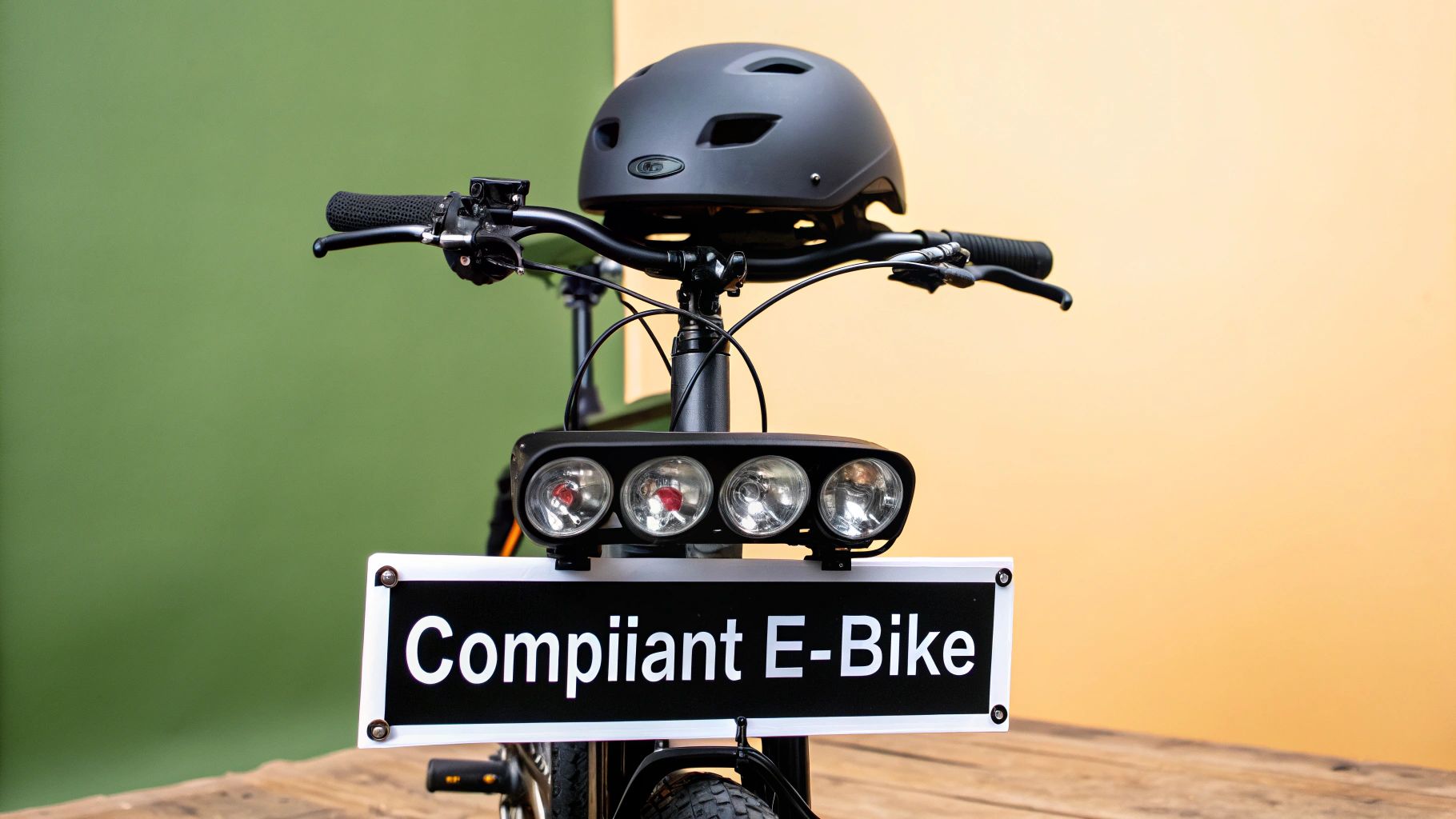
The trick is knowing what to look for before you open your wallet. This way, you can be sure your new e-bike is ready for the road from day one, whether you're cruising city paths in Edmonton or exploring local trails in Kelowna.
How to Choose a Compliant E-Bike
Your absolute top priority is to make sure any e-bike you're considering fits Ontario's legal definition. Any good bike shop will make this information obvious, but it never hurts to be your own expert and check for yourself.
Here are the two non-negotiables to look for:
- Check the Motor Size: The motor's continuous power output must be 500 watts or less. You should find this clearly listed in the bike's technical specs.
- Look for the Compliance Label: Every e-bike legally sold in Canada is required to have a permanent sticker from the manufacturer. This label is your guarantee that it meets all federal and provincial standards, including the 32 km/h speed limit. Think of it as the bike's birth certificate for legal riding.
Verifying these two things takes all the guesswork out of buying an e-bike, giving you total peace of mind that you’ve made a solid, street-legal choice.
Gearing Up for Safety and Comfort
Once you've found your perfect bike, a few essential accessories will make every ride safer and a whole lot more enjoyable. These are the must-haves for hitting the road.
The single most critical piece of gear is your helmet. In Ontario, every e-bike rider—no matter their age—is required to wear an approved bicycle or motorcycle helmet. When you’re shopping, look for a sticker inside from a recognized safety organization like CSA, Snell, or CPSC. That little sticker proves the helmet has passed rigorous testing.
Beyond the helmet, a few other items are simply non-negotiable for safe riding:
- A Bright White Front Light: This is crucial for being seen, especially if you plan to ride at dawn, dusk, or after dark.
- A Red Rear Light or Reflector: Makes you visible to any traffic coming up from behind.
- A Bell or Horn: A simple and effective way to politely alert pedestrians and other riders that you're approaching on shared paths.
For extra comfort across different weather conditions, a versatile neck gaiter is a fantastic addition to your kit. Of course, there are tons of other great items that can level up your rides; we've got more ideas in our guide to the best e-bike accessories.
Best for New Riders: The Step-Thru E-Bike
For anyone just starting out who values comfort and ease of use, it’s tough to beat a step-thru cruiser. The low-slung frame makes hopping on and off a breeze, and the upright riding posture is much kinder to your back and shoulders on longer trips.
If that sounds like your kind of ride, we highly recommend checking out the Biktrix Stunner Step-Thru. It’s fully compliant with Ontario laws, unbelievably comfortable, and perfectly designed for leisurely cruises and daily errands.
Got Questions About Ontario's E-Bike Laws?
We get it. Even after digging into the details, you might still have a few questions rolling around. That’s perfectly normal. To help clear things up, we’ve put together answers to some of the most common things we hear from riders.
Think of this as your quick-reference guide to iron out any last-minute uncertainties, so you can hit the road with total confidence.
Do I Need a Driver's Licence for an E-Bike in Ontario?
Nope! This is one of the best perks of owning an e-bike. As long as your bike fits the province's official definition of a "power-assisted bicycle," you don't need a driver's licence, registration, or even insurance. It's treated just like a regular bicycle under the Highway Traffic Act.
Can I Just Use the Throttle and Not Pedal?
You sure can. Ontario law allows for throttles that can power your e-bike right up to the 32 km/h limit, no pedalling required. It's a fantastic feature for tackling a steep hill or just giving your legs a rest.
But there's one catch: your e-bike must have functional pedals attached at all times to stay legal.
The presence of working pedals is what separates an e-bike from a moped in the eyes of the law. So, even if you’re a big fan of that throttle, the pedals have to stay put!
What If I Modify My E-Bike to Go Faster?
Messing with your e-bike to push it past the 32 km/h assistance limit is a really bad idea. Once you do that, it's no longer considered a "power-assisted bicycle" and can be classified as an illegal motor vehicle by law enforcement.
The consequences can be pretty severe, including:
- Hefty fines for operating an unregistered and uninsured vehicle.
- Demerit points added to your driver's licence (if you have one).
- Your bike could even be seized and impounded.
Honestly, it's just not worth the risk. A compliant e-bike gives you all the speed you need for a fun, safe, and legal ride.
Are the Rules for E-Bikes Different in Cities Like Toronto?
Yes, they often are. The province sets the baseline rules for roads, but individual municipalities have the power to create their own bylaws for specific areas like parks, bike paths, and multi-use trails. This means the rules on a trail in Ottawa might be totally different from one in London.
Before you ride somewhere new, it's always smart to check the local city's website or keep an eye out for posted signs. A quick online search can save you from an unexpected fine and keep your ride stress-free.
Ready to kick off your e-bike adventure on a ride that’s comfortable, stylish, and 100% compliant with Ontario's laws? At Biktrix, we love helping new riders find their perfect match. For anyone just starting out, we often recommend the Biktrix Stunner Step-Thru—its comfortable design and incredible ease of use make it an ideal first e-bike.
