

Ever had one of those bike rides where you wished for a magical tailwind to give you a little push? That’s pretty much what electric bike pedal assist feels like. It’s a smart feature that adds a bit of motorized oomph only when you’re pedaling. It's the secret sauce that flattens out hills and makes long rides feel like a breeze, letting you soak in the scenery without getting winded.
You’re still getting a workout, but it’s like having a helpful friend along for the ride. Ready to find the perfect e-bike that feels like it was made just for you? Our top pick for comfort and ease is the Biktrix Stunner X.
Your Friendly Guide to Pedal Assist
Think of pedal assist as your riding partner, not a replacement for your own effort. It’s not a throttle that does all the work for you. Instead, it’s a clever system that works with you, boosting the power you put into every pedal stroke. This is what makes e-bikes so approachable, especially if you haven't been on a bike in years or you're worried about keeping up.
Picture yourself cruising along the beautiful seawall in Vancouver or the river valley trails in Edmonton. With pedal assist, you’re in complete control of how much help you get. Feeling strong? Keep it on a low setting for just a gentle nudge. Staring down a monster hill on your commute home in Calgary? Crank it up and feel the climb practically disappear. It’s all about making your ride more fun and less of a struggle.
Why Pedal Assist Is a Game-Changer
Let's be honest, the thought of tackling steep hills or long distances can be a bit daunting. Pedal assist erases that worry, giving you the confidence to ride further and explore more.
This technology is perfect for:
- Rediscovering the joy of cycling: It takes the strain out of the ride, so you can focus on the pure fun of being on two wheels.
- Keeping up with the pack: No more getting left behind by faster friends or family members.
- Making your commute a breeze: Arrive at work feeling refreshed, not like you just ran a marathon.
The whole system is beautifully simple. A sensor on the bike knows when you’re pedaling and signals the motor to kick in. You choose the level of assistance with a simple button on your handlebars, usually with a few power levels to pick from. It's so seamless, you'll just feel like you've suddenly developed superhuman legs. If you want to dive deeper into the nuts and bolts, check out our guide on how an electric bike works.
The real beauty of pedal assist is that it keeps you in the game. You're still pedaling, you're still moving, but the motor just takes the edge off. It reduces the strain on your joints and makes the entire experience so much more comfortable.
Whether you're exploring the charming streets of Victoria or planning a scenic ride through Kelowna’s wine country, pedal assist makes sure your journey is all about pleasure. It’s the perfect sidekick for any Canadian adventure.
How Pedal Assist Feels on a Ride
Ever felt like you could use a gentle, perfectly timed push from a helpful friend while riding your bike? That’s exactly what pedal assist feels like. It’s not a sudden jolt or an abrupt burst of power. Instead, it’s a smooth, supportive boost that works right alongside your own pedalling, making the whole experience feel easier and a lot more fun.
The magic behind this feeling comes from a small but critical part called a sensor. This little device is the brain of the whole system, telling the motor precisely when to kick in and lend a hand. There are two main types, and each one creates a totally different ride feel.
Here’s a great way to picture how your effort and the motor’s boost team up.
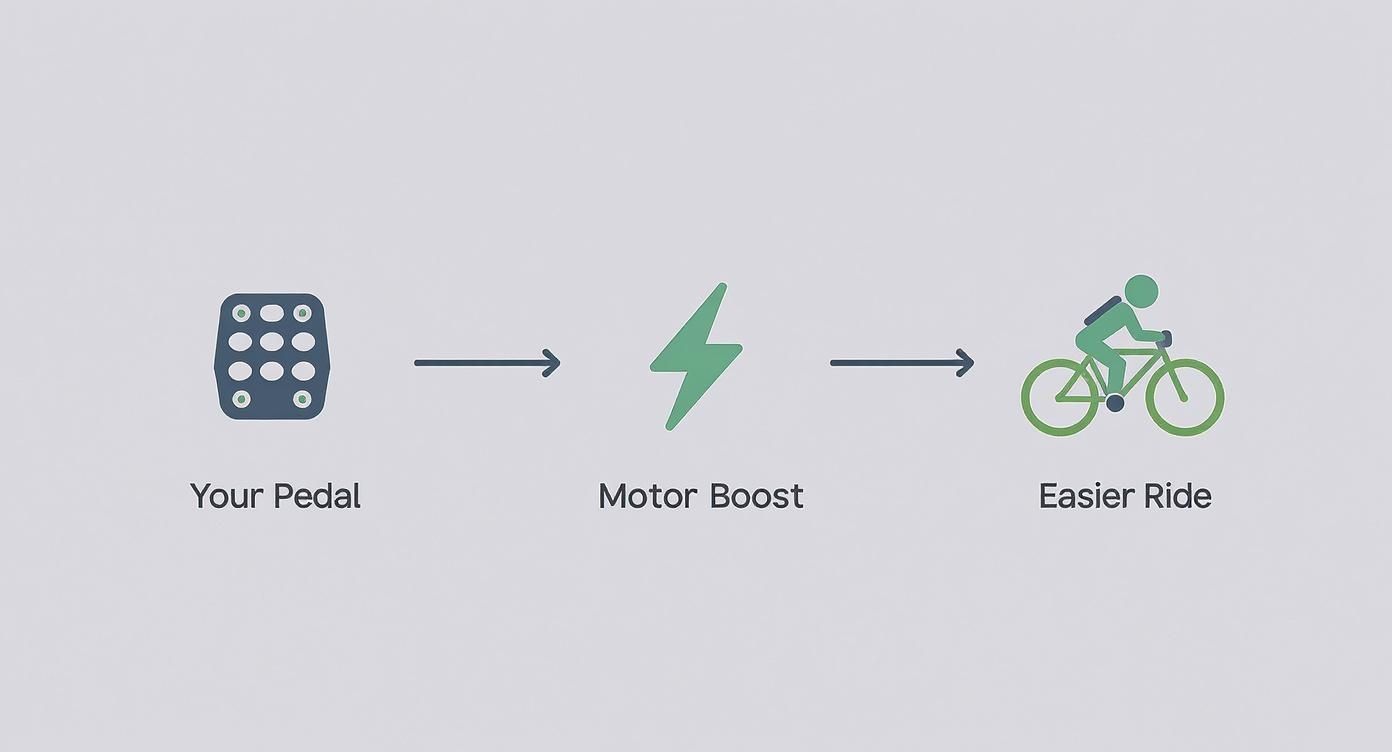
As you can see, the idea is simple: your pedalling gets amplified by the motor, giving you an easier, more enjoyable journey. Now, let's dig into how the two different sensor types change that experience.
The Two Flavours of Pedal Assist Sensors
Getting a handle on the difference between the two main sensors—cadence and torque—is the key to finding a bike that feels perfect for you. One feels more like a simple on/off switch, while the other acts like a smart, intuitive partner that reads your mind.
Cadence Sensors: A Simple Boost
A cadence sensor is the more straightforward of the two. Its job is simple: to detect that your pedals are turning. As soon as it senses motion, it signals the motor to deliver a fixed amount of power based on whatever assist level you’ve selected on your display.
- How it feels: Think of it like a light switch. The moment you start pedalling, the assist turns "on" and gives you a consistent push. It doesn't care how hard or soft you're pedalling; as long as the cranks are moving, you get the full boost for that level. This creates a very steady, predictable feeling.
- Best for: Riders who want a simple, no-fuss system that provides reliable power for leisurely rides. It’s fantastic for flat ground, like the pathways along Edmonton's river valley, where you just want to maintain a comfortable speed.
Torque Sensors: An Intuitive Helper
A torque sensor is a bit more sophisticated, and the ride it delivers feels incredibly natural. Instead of just checking if you're pedalling, it measures how hard you're pedalling. The more muscle you put into it, the more power the motor gives you in return. It’s a dynamic system that perfectly mirrors your own effort.
- How it feels: This feels like your own strength has been supercharged. When you hit a steep hill in Kelowna and start pushing harder, the motor instantly gives you more help. As you ease up on a flat section, the motor eases up, too. This intuitive response makes for a remarkably smooth and controlled ride.
- Best for: Anyone who wants a ride that feels just like a traditional bike, only better. It's ideal for hilly terrain, stop-and-go city traffic in places like Vancouver, and for riders who want precise control over their speed and power.
A torque sensor makes you feel bionic. It’s your power, just magnified. This is why many first-time e-bike riders, especially those who loved traditional cycling, find it to be the most comfortable and confidence-inspiring choice.
Cadence vs Torque Sensors: How They Feel
To make it even clearer, here’s a straightforward comparison of the two sensor types to help you understand the riding experience each one offers.
| Sensor Type | How It Feels to the Rider | Best For |
|---|---|---|
| Cadence | Like an on/off switch. The motor provides a set level of power as soon as you start pedalling, regardless of your effort. | Cruising on flat terrain and leisurely rides. Best for anyone who wants a simple, predictable, and steady boost of power. |
| Torque | Intuitive and natural. The motor amplifies your effort—the harder you pedal, the more power you get. Feels like you're bionic. | Hilly areas and city riding. Best for riders who want a responsive, controlled, and fluid feel that's just like regular biking, but easier. |
Ultimately, the choice between a cadence and a torque sensor really comes down to what you want to feel when you're out on a ride.
And the great news is that even with this amazing boost, you're still getting fantastic physical activity. In fact, many people find they get more exercise on an e-bike simply because they ride more often and for longer distances. You can learn more by reading our article on getting exercise with an e-bike.
Choosing the Right Pedal Assist Level
Your new e-bike comes with a set of pedal assist (PAS) levels, usually numbered from 1 to 5. Don't overthink them—it's best to imagine them as gears for your motor. Getting a feel for these levels is the secret to making every ride exactly what you want it to be, whether that’s a heart-pumping workout or a breezy cruise down to the coffee shop.
Finding your perfect setting is as simple as tapping a button on your handlebars. This one little adjustment lets you decide how much of a push the motor gives you, completely changing the feel of the bike. It's how you'll manage your speed, your effort, and, crucially, how much juice you get out of your battery.
Low Assist Levels (1-2): For Gentle Cruising
The lower settings are your best friends for conserving battery and getting a bit of exercise. They give you a subtle, gentle nudge—almost like having a nice tailwind giving you a friendly push. These levels are perfect for long, flat rides where you just want to keep a comfortable pace without breaking a sweat.
- Best for: A lazy afternoon ride along Calgary's Bow River pathway or a scenic loop around Wascana Lake in Saskatoon. It smooths out the effort just enough to keep you rolling for hours.
Medium Assist Level (3): For Everyday Riding
This is the sweet spot for most day-to-day riding. You get a noticeable boost that creates a fantastic balance between the motor’s help and your own pedalling. It’s got enough punch to let you keep up with city traffic without feeling strained, but still asks you to put in some work.
- Best for: Daily errands or commuting across a city with rolling hills like Edmonton. It makes the ride feel fun and almost effortless without being a major drain on your battery. For a deeper dive into how your bike senses your effort, check out our guide on torque versus cadence sensors on e-bikes.
High Assist Levels (4-5): For Maximum Power
Facing down a real challenge? That's what the higher levels are for. They unleash a powerful surge of assistance that makes even the most intimidating obstacles feel completely doable. These are your go-to settings for conquering those steep, unforgiving hills you find around Victoria or for getting a quick, safe launch from a stoplight.
- Best for: Think of the highest assist level as your secret weapon. You won't use it all the time, but knowing it's there gives you the confidence to take on any route, no matter how challenging it looks on a map.
Just keep in mind, leaning on these higher levels will use up your battery much faster. Save them for when you really need the power. By learning to toggle between the levels strategically, you'll master your battery life and always have the right amount of boost right when you need it.
Pedal Assist vs. Throttle: What's the Difference?
When you first start looking at e-bikes, you’ll run into two terms over and over again: pedal assist and throttle. They both get the motor working for you, but they deliver two totally different ride feels. Getting the distinction is the key to picking an e-bike you’ll absolutely love.
Here’s a simple way to think about it. Pedal assist is like having a pro paddler in the back of your canoe, perfectly matching your stroke. A throttle is more like having a small outboard motor you can fire up to cruise along without paddling at all.
With pedal assist, the motor only kicks in when you’re pedalling. A throttle, on the other hand, is completely independent. You push a lever or twist a grip, and the bike just goes—no pedalling necessary.
When Pedal Assist Is Your Best Friend
For the vast majority of riders, pedal assist is the heart and soul of the e-bike experience. It keeps you connected to the classic feeling of cycling. You feel engaged with the bike and the trail, getting some healthy movement while the motor smooths out the tough parts.
- Best for: Conquering the rolling hills around Kelowna or cruising the beautiful pathways in Saskatoon without worrying about running out of steam. It’s also much kinder to your battery.
When a Throttle Comes in Handy
So if pedal assist is so great, why bother with a throttle? Well, a throttle is your secret weapon for certain situations. It’s brilliant for getting a quick, powerful launch from a standstill, helping you get safely ahead of traffic at a busy intersection in downtown Vancouver.
- Best for: Those moments when you just need a break. Legs feeling a bit tired on the home stretch? Simply stop pedalling and let the throttle take over for a bit. You can even add a Bafang thumb throttle to most of our bikes for ultimate control.
A throttle offers peace of mind. It’s the confidence of knowing you have an 'easy button' to get you home if you're feeling a bit more tired than you expected at the end of your ride.
A Quick Note on Canadian Rules
It’s worth knowing that e-bike regulations can have slight variations across Canada. While most provinces follow similar guidelines, some cities might have their own bylaws about using throttle-equipped bikes on certain multi-use paths.
Generally, if your e-bike meets the federal definition (500W motor, max speed of 32 km/h), you’re clear to ride on most roads. Still, it's always a smart move to do a quick check on your local municipality’s website before you head out.
Finding Your Perfect Pedal Assist E-Bike
Alright, you’ve got the basics of pedal assist down. Now for the fun part: finding the e-bike that feels like it was made just for you. With so many bikes out there, it's easy to get lost in the technical details. But the secret is to forget the long spec sheets and focus on what really matters—your comfort and your enjoyment.
The goal is simple: to find a bike that makes you want to get out and ride.
Advice for the Comfort-Seeking Rider
If your idea of a perfect ride is all about pure enjoyment and cruising in comfort, your priorities should be an upright riding position and a smooth, intuitive feel. A bike that lets you sit tall takes the strain off your back, shoulders, and wrists, turning a simple ride into a genuine pleasure.
- Best for: Someone who wants a natural, fluid boost. For this type of rider, we almost always point towards an e-bike with a torque sensor. It gives you a gentle boost that just makes you feel like a stronger version of yourself.
- Look for features like: Step-thru frames for getting on and off easily, comfortable saddles, and swept-back handlebars.
Advice for the Everyday Commuter
For those of you navigating the daily commute in cities like Calgary or Edmonton, the focus shifts a little. You still want to be comfortable, but now reliability and efficiency enter the picture. You need a workhorse that can handle stop-and-go traffic and get you to the office feeling fresh.
- Best for: A rider needing a balanced bike with a solid mix of power and battery range. A torque sensor is still a fantastic choice for its smooth control in traffic.
- Look for features like: Enough kick to get going at intersections and enough battery to get you home without worry.
Your daily ride should be the best part of your day, not a chore. The right e-bike turns a stressful commute into a refreshing journey, giving you a dose of fresh air and gentle exercise.
Come Feel the Difference for Yourself
Reading about pedal assist is one thing, but actually feeling it is another thing entirely. The best way to truly understand the difference is to take a bike for a spin. We have showrooms in Vancouver and Saskatoon where our team can offer honest, gentle advice with absolutely no pressure.
We can help you find the model that fits your body and your riding style, making sure you go home with a bike that will bring you joy for years to come. For those looking for adventures beyond the bike path, you can read more outdoor adventure tips from our partners.
Our Recommendation for Comfort and Ease:
For first-time riders and anyone who puts a smooth, comfortable, and natural-feeling ride at the top of their list, we highly recommend the Biktrix Stunner X. Its upright riding position, incredibly easy-to-use step-thru frame, and intuitive torque sensor make it the perfect companion for exploring your neighbourhood or local trails with complete confidence.
Simple Care for Your Pedal Assist System
One of the best things about an electric bike pedal assist system is just how simple and reliable it is. There aren't any complicated parts to fuss over, and the whole thing is designed to give you a smooth, worry-free ride. Still, a tiny bit of care now and then will go a long way in keeping that system running perfectly for years.
Think of it like tending to a small garden—a little attention ensures everything blossoms. You don't need to be a bike mechanic. These are just easy, common-sense checks you can do right in your own driveway.
Quick At-Home Checks
Keeping your pedal assist system happy is mostly about keeping it clean and making sure a couple of key parts are in the right spot. A quick look-over once a month is really all it takes.
Here are a few simple things to check:
- Clean Your Sensors: Your e-bike has a small sensor down by the pedals that tells the motor when to kick in. Sometimes, a bit of mud or grime can cover it up. Just wipe it clean with a damp cloth.
- Check the Magnet: There's a small magnet disc that works with the sensor. Make sure it hasn't been knocked out of place and that it's still close to the sensor—usually just a few millimetres away.
- Inspect the Wires: Take a quick glance at the wires running from the motor and sensor. You’re just making sure they aren't snagged or frayed.
Peace of mind is the greatest benefit of a well-maintained e-bike. Knowing your pedal assist system is in top shape means you can head out for a ride in Victoria or along Saskatoon's river trails with complete confidence.
Simple Troubleshooting Tips
So what happens if your assist feels a little off? Don't panic! Most of the time, the solution is incredibly simple and something you can easily fix yourself.
If the assist feels unresponsive:
- Check Your Display: First thing's first: make sure your bike is turned on and you've actually selected a pedal assist level above zero. It sounds silly, but it's a very common oversight!
- Inspect Sensor and Magnet: This is the most likely culprit. A dirty sensor or a misaligned magnet is responsible for most assist issues. Give the sensor a wipe and check the magnet's position.
- Restart Your Bike: Just like a computer, sometimes a simple restart can solve the problem. Turn the bike off, wait about 10 seconds, and turn it back on.
These simple steps will solve the vast majority of minor hiccups. For a broader look at what goes into keeping your ride in great shape, you can read our guide on the true cost of electric bike maintenance.
Common Questions About Pedal Assist
As you get ready to start your e-bike journey, it’s completely normal to have a few questions pop up. We’ve heard them all at our showrooms in Vancouver and Edmonton, so we’ve put together the most common ones to give you the clear, simple answers you’re looking for. Our goal is to make you feel completely confident and excited about your new ride.
Can I Still Get a Good Workout?
Absolutely! This is one of the biggest—and best—surprises for new e-bike owners. The electric bike pedal assist is there to give you a hand, not to do all the work for you. You are always in the driver's seat when it comes to effort. By sticking to a lower assist level, you can get a workout that’s every bit as good as one on a regular bike. The amazing part? Many people find they get more exercise simply because they ride more often and for much longer distances.
How Far Can I Go on One Charge?
Your bike's range depends on the assist level you use, your battery size, and the hills on your route. But the golden rule is simple: the lower the assist level, the longer your battery will last. Most Biktrix bikes can easily cruise for 40 to 80 kilometres or more on a single charge with moderate pedal assist. That’s more than enough for a beautiful day exploring the trails around Kelowna or running all your errands in Calgary.
Is It Hard to Learn How to Use?
Not in the slightest. If you can ride a traditional bicycle, you can ride an e-bike. The feeling is incredibly natural. The power eases in smoothly as you start to pedal, and most new riders tell us they feel perfectly comfortable within the first few minutes. We always suggest starting in a low setting in a safe, open area—like an empty parking lot—just to get a feel for that gentle boost.
Do I Need Pedal Assist if I Have a Throttle?
While having a throttle is fantastic for a quick burst of power, most riders find they use their pedal assist over 90% of the time. Why? It gives you that classic, engaging cycling feel and makes your battery last significantly longer. Think of it this way: pedal assist is for the journey, and the throttle is for a quick push up a hill or getting going from a standstill.
Ready to feel the Biktrix difference for yourself? The Biktrix Stunner X is our top recommendation for riders who value comfort, ease, and a wonderfully natural ride feel. Its step-thru frame and intuitive pedal assist make every journey a joy.
